Concrete masonry units (CMU blocks) are widely used in residential and commercial construction because of their strength, durability, and fire resistance. One of the most important factors contractors and builders consider before starting a masonry project is:
CMU block weight
Understanding concrete block weight helps with:
- Material estimation
- Transportation planning
- Structural calculations
- Labor requirements
- Jobsite handling
In this guide, you will learn the standard weights of CMU blocks, hollow vs solid block differences, pallet weights, lightweight concrete blocks, and common masonry applications.
What Is a CMU Block?
A:
CMU block
stands for:
Concrete Masonry Unit
These concrete blocks are made from:
- Cement
- Sand
- Gravel or stone aggregates
CMU blocks are commonly used for:
- Structural walls
- Foundations
- Retaining walls
- Basements
- Garages
- Commercial construction
Standard CMU Block Weights
The weight of a CMU block depends on:
- Block size
- Density
- Hollow or solid design
- Aggregate type
- Manufacturer
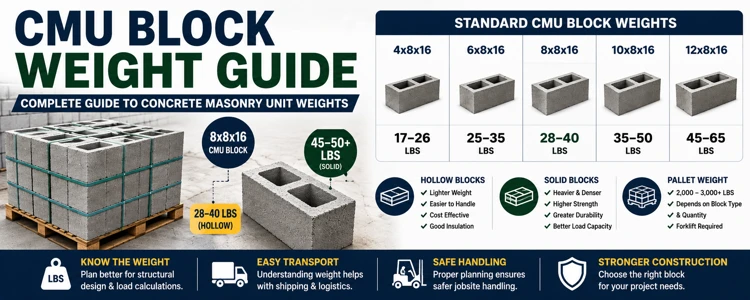
Below are common approximate weights for standard concrete blocks.
| Block Size | Approximate Weight |
|---|---|
| 4x8x16 CMU Block | 17–26 lbs |
| 6x8x16 CMU Block | 25–35 lbs |
| 8x8x16 CMU Block | 28–40 lbs |
| 10x8x16 CMU Block | 35–50 lbs |
| 12x8x16 CMU Block | 45–65 lbs |
Actual weights may vary depending on manufacturer specifications and block density.
Weight of an 8x8x16 CMU Block
The:
8x8x16 CMU block
is one of the most commonly used concrete masonry units in construction.
Typical weights:
- Hollow block → 28–35 lbs
- Medium-weight block → 35–40 lbs
- Solid block → 45–50+ lbs
Because of its balance between strength and handling, the 8x8x16 block is widely used for:
- Structural walls
- Garage walls
- Foundations
- Commercial masonry
Hollow vs Solid CMU Block Weight
Hollow CMU Blocks
Hollow blocks contain internal voids that reduce weight.
Advantages:
- Easier to transport
- Lower shipping costs
- Easier installation
- Improved insulation
These are the most commonly used concrete blocks in residential construction.
Solid CMU Blocks
Solid concrete blocks are:
- Heavier
- Denser
- Stronger
Advantages:
- Greater load-bearing capacity
- Better durability
- Improved sound insulation
Solid blocks are commonly used for:
- Retaining walls
- Heavy structural walls
- Foundations
Lightweight vs Normal Weight CMU Blocks
CMU blocks are available in different density categories.
Lightweight CMU Blocks
Lightweight blocks use aggregates such as:
- Expanded shale
- Pumice
- Lightweight stone
Benefits:
- Easier handling
- Reduced structural load
- Improved insulation
Normal Weight CMU Blocks
Normal-weight blocks use:
- Sand
- Gravel
- Stone aggregates
Benefits:
- Higher compressive strength
- Better durability
- Improved structural performance
These blocks are commonly used in commercial construction.
CMU Block Pallet Weight
Concrete blocks are commonly shipped on pallets.
Typical pallet weights:
- 2,000 lbs
- 2,500 lbs
- 3,000+ lbs
Pallet weight depends on:
- Number of blocks
- Block density
- Moisture content
- Hollow or solid design
Heavy pallets require forklifts or specialized equipment for handling.
Why CMU Block Weight Matters
Understanding block weight is important for:
- Structural engineering
- Transportation
- Labor planning
- Material handling
- Safety
Heavier blocks generally provide:
- Better strength
- Greater durability
- Higher load capacity
However, they may also increase:
- Labor requirements
- Transportation costs
Common Uses of CMU Blocks
Concrete masonry units are widely used for:
- Foundation walls
- Retaining walls
- Basement walls
- Commercial buildings
- Residential walls
- Masonry partitions
CMU blocks remain one of the most durable and cost-effective construction materials available.
CMU Blocks vs Cinder Blocks
Many people use the terms:
cinder block
and
concrete block
interchangeably.
However, modern construction primarily uses:
CMU concrete blocks
because they are stronger, denser, and more durable than traditional cinder blocks.
Use a CMU Block Calculator
Before starting masonry construction, it is important to estimate:
- Block quantity
- Mortar bags
- Material costs
- Wall dimensions
Our CMU Block Calculator helps estimate:
- Concrete block quantities
- Mortar requirements
- Wall area coverage
- Material costs
You can also use:
for additional construction estimation.
Tips for Handling Heavy CMU Blocks
When working with concrete blocks:
- Wear gloves
- Use proper lifting techniques
- Avoid overloading pallets
- Store blocks on level surfaces
- Use forklifts for heavy deliveries
Proper handling improves construction safety and reduces material damage.
Final Thoughts
CMU block weight varies depending on block size, density, and design. Standard 8x8x16 concrete blocks typically weigh between 28 and 40 pounds, while solid blocks can weigh significantly more. Understanding concrete block weight helps contractors estimate transportation, labor, structural loads, and construction costs more accurately.
Using a CMU Block Calculator can simplify masonry estimation and improve construction planning for residential and commercial projects.