The:
8x8x16 CMU block
is one of the most commonly used concrete masonry units in residential and commercial construction. These concrete blocks are widely used for structural walls, foundations, retaining walls, garages, and masonry construction projects because they provide excellent strength, durability, and fire resistance.
In this guide, you will learn the exact dimensions, actual size, weight, coverage area, common uses, and construction applications of 8x8x16 CMU blocks.
What Does 8x8x16 Mean?
The term:
8x8x16
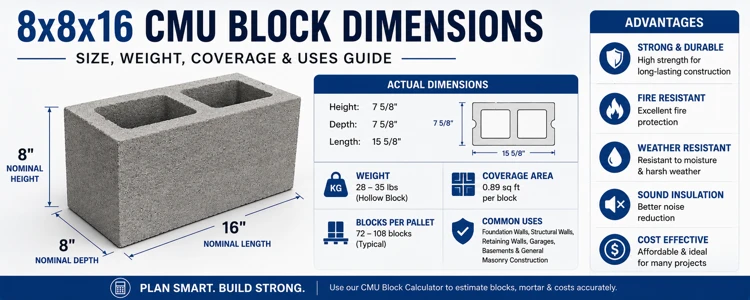
represents the nominal dimensions of a CMU block.
This means the block is approximately:
- 8 inches high
- 8 inches deep
- 16 inches long
These measurements include the mortar joint spacing used during masonry construction.
Actual Dimensions of an 8x8x16 CMU Block
The actual dimensions are slightly smaller than the nominal size.
Typical actual size:
- 7 5/8 inches high
- 7 5/8 inches deep
- 15 5/8 inches long
The smaller size allows space for:
mortar joints
between concrete blocks during installation.
Why Actual Size Is Smaller
Concrete masonry units are manufactured slightly smaller so that when mortar joints are added, the installed wall dimensions match the nominal measurements.
Most standard masonry walls use:
3/8-inch mortar joints
This creates uniform wall spacing and improves construction accuracy.
Weight of an 8x8x16 CMU Block
The weight of a standard 8x8x16 concrete block depends on:
- Block density
- Aggregate type
- Manufacturer
- Hollow or solid design
Typical weights:
- Hollow block → 28–35 lbs
- Medium-weight block → 35–40 lbs
- Solid block → 45–50+ lbs
Lightweight blocks are easier to handle, while heavier blocks provide greater strength and durability.
Coverage Area of an 8x8x16 Block
A standard:
8x8x16 CMU block
covers approximately:
0.89 square feet
This helps contractors estimate:
- Number of blocks required
- Wall coverage
- Material quantities
- Construction costs
Using accurate block coverage calculations reduces material waste and improves project planning.
Common Uses of 8x8x16 CMU Blocks
8x8x16 concrete blocks are commonly used for:
- Foundation walls
- Structural walls
- Retaining walls
- Basement walls
- Garage walls
- Commercial buildings
- Residential masonry projects
Because of their strength and durability, these blocks are one of the most popular masonry materials in construction.
Hollow vs Solid CMU Blocks
Hollow CMU Blocks
Hollow blocks contain internal voids that:
- Reduce weight
- Improve insulation
- Allow reinforcement placement
- Reduce material costs
These are the most commonly used concrete blocks in masonry construction.
Solid CMU Blocks
Solid blocks are denser and heavier.
Advantages:
- Higher strength
- Better sound insulation
- Increased durability
They are commonly used in:
- Heavy-load walls
- Retaining walls
- Structural applications
Standard CMU Block Sizes
In addition to 8x8x16 blocks, other common CMU block sizes include:
| Block Size | Common Use |
|---|---|
| 4x8x16 | Partition walls |
| 6x8x16 | Residential walls |
| 8x8x16 | Structural walls |
| 10x8x16 | Commercial walls |
| 12x8x16 | Retaining walls |
The:
8x8x16 CMU block
remains the industry standard for many masonry projects.
How Many 8x8x16 Blocks Per Pallet?
The number of blocks per pallet depends on:
- Manufacturer
- Block type
- Shipping configuration
Typical pallets contain:
- 72 blocks
- 90 blocks
- 108 blocks
Pallet quantities are important for estimating transportation and material handling costs.
Advantages of 8x8x16 CMU Blocks
Concrete masonry units provide several benefits:
- High durability
- Fire resistance
- Moisture resistance
- Long lifespan
- Low maintenance
- Strong structural performance
CMU block walls are commonly used because they provide excellent long-term strength and stability.
CMU Blocks vs Cinder Blocks
Many people use the terms:
cinder block
and
concrete block
interchangeably.
However, modern construction primarily uses:
CMU concrete blocks
because they are stronger and more durable than traditional cinder blocks.
Use a CMU Block Calculator
Before starting masonry construction, it is important to estimate:
- Block quantity
- Mortar bags
- Material costs
- Wall dimensions
Our CMU Block Calculator helps estimate:
- Concrete block quantities
- Mortar requirements
- Wall area coverage
- Material costs
You can also use:
for additional construction estimation.
Final Thoughts
The 8x8x16 CMU block is one of the most widely used concrete masonry units in residential and commercial construction. Its strength, durability, fire resistance, and standard dimensions make it ideal for structural walls, foundations, garages, and masonry projects.
Understanding actual dimensions, block coverage, weight, and pallet quantities helps contractors and homeowners estimate materials more accurately and improve construction planning.