
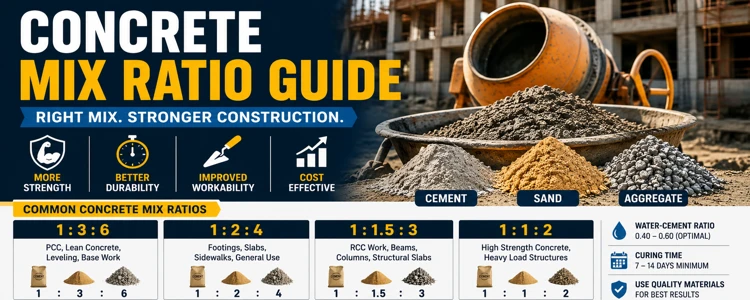
Concrete mix ratio is one of the most important factors in construction because it directly affects concrete strength, durability, workability, and long-term performance. Whether you are building a slab, footing, driveway, foundation, column, or beam, using the correct concrete mix ratio is essential for achieving strong and reliable construction.
In this guide, you will learn common concrete mix ratios, cement-sand-aggregate proportions, RCC and PCC ratios, and how to choose the right mix for different construction projects.
What Is a Concrete Mix Ratio?
A concrete mix ratio represents the proportion of:
- Cement
- Sand
- Aggregate
used to make concrete.
Example:
1:2:4
means:
- 1 part cement
- 2 parts sand
- 4 parts aggregate
Water is then added to create workable concrete.
Why Concrete Mix Ratio Is Important
The correct mix ratio helps:
- Increase concrete strength
- Improve durability
- Reduce cracking
- Improve workability
- Extend structure life
Using too much water or incorrect material proportions can weaken concrete significantly.
Common Concrete Mix Ratios
| Mix Ratio | Common Use |
|---|---|
| 1:3:6 | PCC and leveling |
| 1:2:4 | General construction |
| 1:1.5:3 | RCC work |
| 1:1:2 | High-strength concrete |
1:3:6 Concrete Mix Ratio
This is a lean concrete mix commonly used for:
- Base concrete
- Leveling
- Sidewalks
- Non-structural applications
Advantages:
- Lower cement consumption
- Economical
- Easy to work with
However, it provides lower strength compared to richer mixes.
1:2:4 Concrete Mix Ratio
The 1:2:4 ratio is one of the most widely used concrete mixes in construction.
Uses:
- Slabs
- Footings
- Sidewalks
- Residential construction
- Small foundations
This mix provides a good balance between:
- Strength
- Durability
- Cost
1:1.5:3 Concrete Mix Ratio
This mix is commonly used for:
RCC (Reinforced Cement Concrete)
Applications:
- Beams
- Columns
- Structural slabs
- Heavy-load structures
Advantages:
- Higher compressive strength
- Better durability
- Improved structural performance
1:1:2 Concrete Mix Ratio
This is a high-strength concrete mix.
Used for:
- Bridges
- Commercial buildings
- Heavy structural members
- Industrial construction
It contains a higher cement content, resulting in:
- Greater strength
- Reduced permeability
- Improved durability
PCC vs RCC Concrete Mix
PCC (Plain Cement Concrete)
PCC contains:
- Cement
- Sand
- Aggregate
but:
no reinforcement steel
Common uses:
- Flooring base
- Pavements
- Sidewalks
- Leveling work
Typical PCC ratio:
1:3:6
RCC (Reinforced Cement Concrete)
RCC contains:
- Cement
- Sand
- Aggregate
- Reinforcement steel (rebar)
Used for:
- Beams
- Columns
- Structural slabs
- Foundations
Typical RCC ratio:
1:1.5:3
Water-Cement Ratio
The water-cement ratio is extremely important in concrete quality.
Too much water can:
- Reduce strength
- Increase cracking
- Cause shrinkage
Too little water can:
- Reduce workability
- Make concrete difficult to place
Typical water-cement ratio:
0.40 to 0.60
How to Calculate Materials for Concrete
To estimate materials:
- Determine concrete volume
- Select concrete mix ratio
- Calculate cement, sand, and aggregate quantities
Using a calculator simplifies this process significantly.
Cement Bags Required for Concrete
Approximate cement requirements:
| Mix Ratio | Cement Bags per Cubic Meter |
|---|---|
| 1:3:6 | 4–5 bags |
| 1:2:4 | 6–7 bags |
| 1:1.5:3 | 8–9 bags |
Actual values may vary depending on:
- Moisture content
- Aggregate type
- Construction method
Factors Affecting Concrete Strength
Concrete strength depends on:
- Mix ratio
- Water-cement ratio
- Curing quality
- Aggregate quality
- Cement quality
- Compaction
Proper curing is essential for strong concrete.
Concrete Curing Importance
Concrete should be cured properly for:
at least 7–14 days
Benefits:
- Increased strength
- Reduced cracking
- Improved durability
- Better long-term performance
Choosing the Right Concrete Mix Ratio
The best mix ratio depends on:
- Structural load
- Construction type
- Exposure conditions
- Building codes
General recommendation:
- PCC → 1:3:6
- Residential slabs → 1:2:4
- RCC structures → 1:1.5:3
Use a Concrete Calculator
Manual concrete calculations can be time-consuming.
Our online calculators help estimate:
- Concrete volume
- Cement bags
- Sand quantity
- Aggregate quantity
- Material costs
You can also use:
- Concrete Volume Calculator
- Foundation Calculator
- Gravel Calculator
for more accurate estimation.
Final Thoughts
Understanding concrete mix ratios is essential for strong and durable construction. Selecting the correct cement, sand, and aggregate proportion improves structural performance, reduces cracking, and increases project life.
Whether you are building a slab, footing, driveway, or foundation, using the proper concrete mix ratio ensures better construction quality and long-term durability.