Concrete blocks and cinder blocks are commonly used in construction projects across the United States. Many people use these terms interchangeably, but they are not exactly the same. Understanding the difference between concrete blocks and cinder blocks is important when selecting the right material for:
- Walls
- Foundations
- Retaining walls
- Structural construction
In this guide, we will explain the major differences between concrete blocks and cinder blocks, including:
- Strength
- Weight
- Durability
- Cost
- Uses
- Structural performance
and which option is better for modern construction.
What Is a Concrete Block?
A:
concrete block
also known as a:
CMU (Concrete Masonry Unit)
is made using:
- Cement
- Sand
- Gravel
- Water
- Aggregate materials
Concrete blocks are designed for:
- Strength
- Durability
- Structural performance
They are widely used in:
- Structural walls
- Foundations
- Commercial buildings
- Retaining walls
- Residential construction
The most common size is:
8x8x16 CMU block
Concrete blocks are considered the standard masonry material in modern construction.
You can also read:
What Is a CMU Block?What Is a Cinder Block?
Cinder blocks
are similar to concrete blocks but contain:
- Coal cinders
- Fly ash
- Lightweight aggregate materials
Traditionally, cinder blocks were lighter than concrete blocks because they used:
- Ash
- Cinders
instead of stone aggregate.
Cinder blocks were commonly used in:
- Older construction projects
- Non-load-bearing walls
- Small masonry applications
Main Difference Between Concrete Block and Cinder Block
The biggest difference is:
material composition
Concrete Blocks Use:
- Stone aggregate
- Sand
- Cement
Cinder Blocks Use:
- Coal cinders
- Fly ash
- Lightweight materials
This affects:
- Strength
- Weight
- Durability
- Structural performance
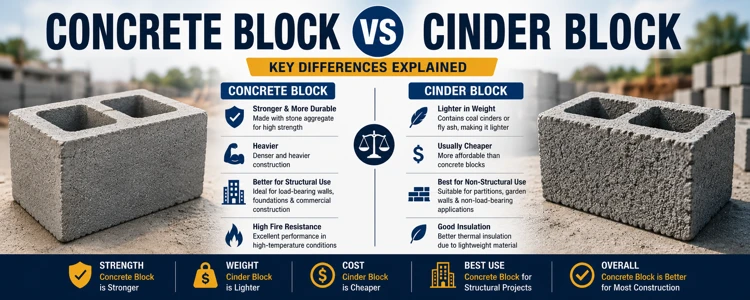
Concrete Block vs Cinder Block Comparison
| Feature | Concrete Block | Cinder Block |
|---|---|---|
| Strength | Higher | Lower |
| Weight | Heavier | Lighter |
| Durability | More durable | Less durable |
| Fire Resistance | Excellent | Good |
| Structural Use | Yes | Limited |
| Cost | Slightly higher | Usually cheaper |
| Modern Use | Very common | Less common |
Which Is Stronger?
Concrete blocks are stronger.
Because they contain:
stone aggregate
concrete blocks provide:
- Higher compressive strength
- Better durability
- Improved load-bearing capacity
This makes them ideal for:
- Foundations
- Structural walls
- Commercial construction
- Reinforced masonry systems
Cinder blocks are generally weaker and are not preferred for:
- Heavy structural loads
- Major commercial construction
You can also read:
CMU Compressive Strength GuideWhich Is Lighter?
Cinder blocks are lighter.
The lightweight cinder material reduces overall block weight.
Advantages include:
- Easier handling
- Faster installation
- Reduced transportation weight
However:
lighter weight also means:
reduced structural strength
You can also read:
CMU Block Weight GuideDurability Comparison
Concrete blocks are:
more durable and long-lasting
They resist:
- Moisture
- Weather damage
- Cracking
- Structural stress
Cinder blocks may deteriorate faster over time, especially in areas exposed to:
- Heavy moisture
- Freeze-thaw cycles
- Extreme weather conditions
You can also read:
CMU Freeze-Thaw Resistance GuideFire Resistance
Both concrete blocks and cinder blocks offer good:
fire resistance
However:
concrete blocks
generally perform better in:
- High-temperature environments
- Fire-rated construction
This is one reason why CMU blocks are commonly used in:
- Commercial buildings
- Warehouses
- Fire-rated walls
You can also read:
CMU Fire Rating GuideCost Difference
Cinder blocks are usually:
slightly cheaper
because they use lightweight materials.
However:
concrete blocks provide:
- Better strength
- Longer lifespan
- Lower maintenance
which often makes them more cost-effective in the long term.
Common Uses of Concrete Blocks
Concrete blocks are commonly used for:
- Foundations
- Load-bearing walls
- Retaining walls
- Commercial buildings
- Schools
- Warehouses
- Residential structures
Modern masonry construction heavily relies on:
concrete blocks
Common Uses of Cinder Blocks
Cinder blocks are often used for:
- Garden walls
- Small partitions
- Decorative walls
- Non-structural projects
- Temporary structures
They are less common in modern structural construction.
Are Cinder Blocks Still Used Today?
Yes, but:
concrete blocks are much more common today
Most modern building projects use:
CMU blocks
because they provide:
- Better structural performance
- Higher durability
- Improved safety
The term:
“cinder block”
is still widely used informally, even when people are actually referring to:
concrete blocks
Which Is Better?
For most construction projects:
concrete blocks are the better choice
Advantages include:
- Higher strength
- Better durability
- Improved fire resistance
- Longer lifespan
- Better structural reliability
Cinder blocks may still be useful for:
- Lightweight applications
- Non-load-bearing walls
- Small outdoor projects
Hollow vs Solid Blocks
Many modern concrete blocks are available in:
- Hollow designs
- Solid designs
You can also read:
Hollow vs Solid Concrete Blocksto understand the structural differences.
How to Choose the Right Block
When selecting masonry materials, consider:
- Project type
- Structural requirements
- Budget
- Climate conditions
- Local building codes
Structural walls should generally use:
Concrete Masonry Units (CMU blocks)
Use a CMU Block Calculator
Before starting a construction project, accurate material estimation is important.
Our:
CMU Block Calculatorhelps you:
- Estimate concrete blocks
- Calculate mortar bags
- Estimate project costs
- Add waste percentage
- Support multiple block sizes
Using a calculator improves:
- Planning accuracy
- Material estimation
- Construction efficiency
You can also use:
- Concrete Volume Calculator
- Foundation Calculator
- Gravel Calculator
- Mortar Calculator
- Rebar Calculator
for additional construction estimation.
Frequently Asked Questions
Are cinder blocks weaker than concrete blocks?
Yes.
Cinder blocks are generally weaker because they use:
- Lightweight materials
- Coal cinders
instead of dense stone aggregate.
Are concrete blocks load-bearing?
Yes.
Most CMU blocks are designed for:
- Structural walls
- Foundations
- Commercial construction
Why are cinder blocks lighter?
Cinder blocks use:
- Coal cinders
- Fly ash
- Lightweight materials
which reduce overall block density.
Which block is better for foundations?
Concrete blocks are generally better because they provide:
- Higher strength
- Better durability
- Improved structural stability
Related Articles
- What Is a CMU Block?
- CMU Compressive Strength Guide
- CMU Block Weight Guide
- CMU Fire Rating Guide
- CMU Freeze-Thaw Resistance Guide
- Hollow vs Solid Concrete Blocks
- Lightweight vs Normal Weight CMU
Final Thoughts
Concrete blocks and cinder blocks may look similar, but they differ in:
- Strength
- Weight
- Durability
- Material composition
Concrete blocks are stronger and better suited for:
- Modern construction
- Structural walls
- Foundations
- Commercial masonry systems
while cinder blocks are lighter and mainly used for:
- Small projects
- Non-structural walls
- Decorative applications
Understanding the difference helps:
- Homeowners
- Contractors
- Builders
- Engineers
choose the correct masonry material for long-lasting construction performance 👍