CMU Wall Thickness Guide
Concrete masonry unit (CMU) walls are widely used in residential and commercial construction because they provide excellent:
- Strength
- Durability
- Fire resistance
- Structural stability
One of the most important factors in masonry wall construction is:
wall thickness
Choosing the correct CMU wall thickness helps improve:
- Structural performance
- Load-bearing capacity
- Insulation
- Fire resistance
- Construction durability
In this guide, you will learn standard CMU wall thicknesses, common concrete block sizes, structural applications, and how to choose the right wall thickness for your project.
What Is CMU Wall Thickness?
CMU wall thickness refers to:
the width of the concrete masonry wall measured from one side to the other
Wall thickness depends on:
- Block size
- Structural requirements
- Building height
- Load-bearing needs
- Local building codes
Thicker walls generally provide:
- Higher strength
- Better stability
- Improved durability
Standard CMU Wall Thicknesses
Concrete block walls are available in several standard thicknesses depending on project requirements.
| Nominal Thickness | Actual Thickness |
|---|---|
| 4 inch | 3 5/8 inch |
| 6 inch | 5 5/8 inch |
| 8 inch | 7 5/8 inch |
| 10 inch | 9 5/8 inch |
| 12 inch | 11 5/8 inch |
The:
8-inch CMU wall
is one of the most commonly used wall thicknesses in residential and commercial construction.
You can also view:
CMU Block Sizes Chartfor detailed block dimensions and common uses.
You can also read:
CMU Nominal vs Actual Dimensionsto understand how nominal and actual concrete block sizes work.
4-Inch CMU Walls
4-inch concrete block walls are commonly used for:
- Interior partition walls
- Non-load-bearing walls
- Decorative masonry walls
Advantages:
- Lightweight
- Lower material costs
- Easier installation
These walls are generally not suitable for heavy structural loads.
6-Inch CMU Walls
6-inch CMU walls are commonly used for:
- Residential walls
- Garage walls
- Small structural applications
These walls provide a balance between:
- Strength
- Cost efficiency
- Material usage
6-Inch vs 8-Inch CMU Walls
| Feature | 6-Inch CMU Wall | 8-Inch CMU Wall |
|---|---|---|
| Strength | Moderate | Higher |
| Load Bearing | Limited | Excellent |
| Cost | Lower | Higher |
| Insulation | Moderate | Better |
| Common Uses | Residential & partitions | Structural & commercial |
The:
8-inch CMU wall
is generally preferred for:
- Structural masonry
- Commercial construction
- Foundations
- Retaining walls
because it provides:
- Better stability
- Higher load capacity
- Improved durability
8-Inch CMU Walls
The:
8-inch CMU wall
is one of the most widely used concrete masonry wall thicknesses.
Applications:
- Structural walls
- Basement walls
- Foundations
- Commercial buildings
- Retaining walls
Because of its durability and load-bearing capacity, it is commonly used in modern masonry construction.
You can learn more in:
8x8x16 CMU Block Dimensions10-Inch and 12-Inch CMU Walls
Thicker concrete block walls are commonly used for:
- Heavy structural walls
- Retaining walls
- Commercial construction
- High-load applications
Advantages:
- Greater stability
- Higher compressive strength
- Improved durability
These walls typically require additional reinforcement and foundation support.
Load-Bearing vs Non-Load-Bearing Walls
Load-Bearing CMU Walls
Load-bearing walls support structural weight from:
- Roof systems
- Floors
- Upper levels
These walls usually require:
- Thicker blocks
- Reinforcement steel
- Grouted cells
Non-Load-Bearing Walls
Non-load-bearing walls are primarily used for:
- Space division
- Partition walls
- Decorative construction
These walls typically use:
- Smaller block sizes
- Lighter construction methods
CMU Wall Reinforcement
Concrete block walls often include:
- Rebar reinforcement
- Grout filling
- Horizontal joint reinforcement
Reinforcement improves:
- Structural strength
- Crack resistance
- Wind resistance
- Seismic performance
You can estimate reinforcement using the:
Rebar CalculatorYou can also read:
CMU Seismic Design GuideCMU Wall Cost and Thickness
Thicker walls generally cost more because they require:
- Larger blocks
- Additional mortar
- More labor
- Reinforcement materials
However, thicker walls also provide:
- Better structural performance
- Longer lifespan
- Improved stability
You can also read:
CMU Block Cost Per Square Footto understand masonry construction costs.
CMU Thermal and Sound Performance
Thicker concrete masonry walls usually provide:
- Better thermal insulation
- Improved sound resistance
- Greater thermal mass
You can also read:
CMU Thermal Insulation Guideand:
CMU Sound Transmission Guidefor more information.
Foundation Requirements for CMU Walls
Concrete block walls require properly designed foundations to support structural loads.
Foundation requirements depend on:
- Wall thickness
- Soil conditions
- Building loads
- Local building codes
You can estimate foundation concrete using the:
Foundation CalculatorHow to Choose the Right CMU Wall Thickness
Choosing the correct wall thickness depends on:
- Structural requirements
- Building type
- Wall height
- Local codes
- Climate conditions
General recommendations:
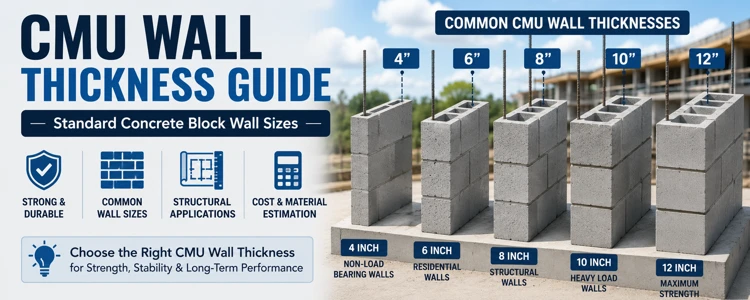
- 4-inch → partition walls
- 6-inch → residential walls
- 8-inch → structural walls
- 10–12 inch → heavy-load walls
Consulting a structural engineer is recommended for large commercial projects.
Frequently Asked Questions
What is the standard CMU wall thickness?
The most common CMU wall thicknesses are:
- 4 inch
- 6 inch
- 8 inch
- 10 inch
- 12 inch
The:
8-inch CMU wall
is one of the most widely used structural masonry wall systems.
Is an 8-inch CMU wall load-bearing?
Yes.
An:
8-inch CMU wall
is commonly used for:
- Structural walls
- Foundations
- Basement walls
- Commercial masonry construction
What is the minimum CMU wall thickness?
4-inch CMU walls are commonly used as:
- Non-load-bearing walls
- Interior partition walls
Structural applications usually require thicker walls.
Which is better: 6-inch or 8-inch CMU wall?
8-inch CMU walls generally provide:
- Better structural strength
- Improved durability
- Higher load-bearing capacity
6-inch walls may be suitable for:
- Smaller residential projects
- Light structural applications
Use a CMU Block Calculator
Before starting masonry construction, it is important to estimate:
- Block quantity
- Mortar bags
- Wall dimensions
- Material costs
- Waste allowance
Our:
CMU Block Calculatorhelps estimate:
- Concrete block quantities
- Mortar requirements
- Wall coverage
- Material costs
You can also use:
Related Calculators
- Concrete Volume Calculator
- Gravel Calculator
- Foundation Calculator
- Rebar Calculator
- Mortar Calculator
for additional construction estimation.
Related Articles
- CMU Block Sizes Chart
- Standard Cinder Block Sizes
- 8x8x16 CMU Block Dimensions
- CMU Block Weight Guide
- CMU Block Cost Per Square Foot
- How Many CMU Blocks Per Pallet?
- CMU Nominal vs Actual Dimensions
- Lightweight vs Normal Weight CMU
Final Thoughts
CMU wall thickness plays an important role in masonry construction performance, structural stability, and project durability. Choosing the correct concrete block wall thickness helps improve:
- Load-bearing capacity
- Fire resistance
- Insulation
- Long-term wall performance
The:
8-inch CMU wall
remains one of the most commonly used wall thicknesses because it provides an excellent balance between:
- Strength
- Durability
- Construction efficiency 👍