
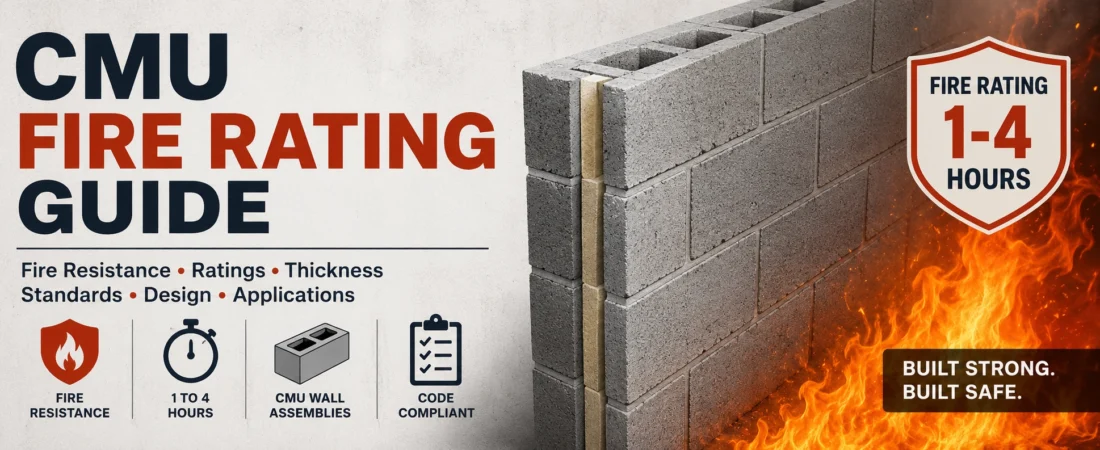
Concrete masonry units (CMU blocks) are widely used in residential and commercial construction because they provide excellent:
- Fire resistance
- Structural strength
- Durability
- Safety performance
One of the biggest advantages of concrete block construction is:
Fire resistance
CMU walls can help slow the spread of fire and improve building safety during emergencies.
In this guide, you will learn about CMU fire ratings, fire-resistant wall assemblies, block thickness, ASTM standards, and how concrete masonry improves fire protection in construction projects.
What Is a CMU Fire Rating?
A:
CMU fire rating
refers to the amount of time a concrete masonry wall can resist fire exposure while maintaining:
- Structural stability
- Integrity
- Heat resistance
Fire ratings are commonly measured in:
- Hours
- ASTM fire testing standards
Typical fire ratings include:
- 1-hour walls
- 2-hour walls
- 3-hour walls
- 4-hour walls
Why CMU Blocks Are Fire Resistant
Concrete blocks are naturally fire resistant because they are made from:
- Cement
- Sand
- Aggregate
- Mineral-based materials
Unlike wood framing, CMU walls:
- Do not burn
- Do not produce toxic smoke
- Help contain fire spread
This makes concrete masonry one of the safest building materials for:
- Residential construction
- Commercial buildings
- Schools
- Warehouses
- Industrial facilities
CMU Fire Rating by Wall Thickness
Fire resistance generally increases with wall thickness.
Approximate CMU fire ratings:
| CMU Wall Thickness | Approximate Fire Rating |
|---|---|
| 4-inch CMU Wall | 1 hour |
| 6-inch CMU Wall | 2 hours |
| 8-inch CMU Wall | 2–4 hours |
| 10-inch CMU Wall | 3–4 hours |
| 12-inch CMU Wall | 4+ hours |
Actual ratings depend on:
- Aggregate type
- Wall assembly
- Reinforcement
- Grouting
- Local building codes
You can also read:
CMU Wall Thickness Guidefor wall thickness information.
8-Inch CMU Fire Rating
The:
8-inch CMU wall
is one of the most common fire-rated masonry assemblies used in construction.
Advantages:
- Strong structural performance
- Excellent fire resistance
- Good sound insulation
- High durability
8-inch concrete block walls are commonly used in:
- Commercial buildings
- Foundations
- Schools
- Warehouses
- Fire separation walls
You can also learn more in:
8x8x16 CMU Block DimensionsHollow vs Solid CMU Fire Resistance
Hollow CMU Blocks
Hollow concrete blocks provide:
- Reduced weight
- Easier installation
- Good fire resistance
Grouted hollow walls can significantly improve fire performance.
Solid Concrete Blocks
Solid CMU blocks:
- Are denser
- Provide greater fire resistance
- Offer improved structural strength
These are commonly used for:
- Fire walls
- Structural barriers
- Industrial applications
ASTM Fire Testing Standards
CMU fire ratings are commonly evaluated using:
ASTM E119
This standard tests:
- Fire endurance
- Structural performance
- Heat transfer resistance
Building codes use these standards to determine required fire ratings for:
- Commercial walls
- Stairwells
- Fire barriers
- Separation walls
Fire-Rated CMU Applications
Fire-rated concrete block walls are commonly used for:
- Commercial buildings
- Apartment buildings
- Schools
- Hospitals
- Industrial facilities
- Fire separation walls
CMU construction helps improve:
- Occupant safety
- Structural protection
- Building code compliance
Benefits of Fire-Rated CMU Walls
Concrete masonry fire-rated walls provide:
- Non-combustible construction
- Reduced fire spread
- Lower maintenance
- Improved durability
- Better structural stability
These advantages make CMU one of the most trusted materials for fire-resistant construction.
CMU Density and Fire Resistance
Block density can affect fire performance.
Medium-weight and normal-weight blocks often provide:
- Better fire endurance
- Improved structural stability
You can also read:
CMU Block Density GuideCMU Fire Rating and Building Codes
Local building codes may require minimum fire ratings depending on:
- Occupancy type
- Building height
- Wall location
- Structural design
Always consult:
- Local building regulations
- Structural engineers
- Fire safety requirements
before finalizing masonry wall assemblies.
Use a CMU Block Calculator
Before starting masonry construction, it is important to estimate:
- Block quantities
- Mortar requirements
- Wall dimensions
- Material costs
Our:
CMU Block Calculatorhelps estimate:
- Concrete block quantities
- Mortar requirements
- Material costs
- Wall coverage
You can also use:
- Foundation Calculator
- Gravel Calculator
- Rebar Calculator
- Concrete Volume Calculator
for additional construction estimation.
Related Articles
- CMU Wall Thickness Guide
- CMU Block Density Guide
- CMU Block Sizes Chart
- 8x8x16 CMU Block Dimensions
- CMU Block Weight Guide
- Cinder Block vs Concrete Block
Final Thoughts
CMU fire ratings play an important role in building safety, structural protection, and fire-resistant construction. Concrete masonry walls provide excellent fire endurance because they are non-combustible, durable, and structurally stable.
Choosing the correct CMU wall thickness and fire-rated wall assembly helps improve safety, meet building codes, and enhance long-term construction performance.