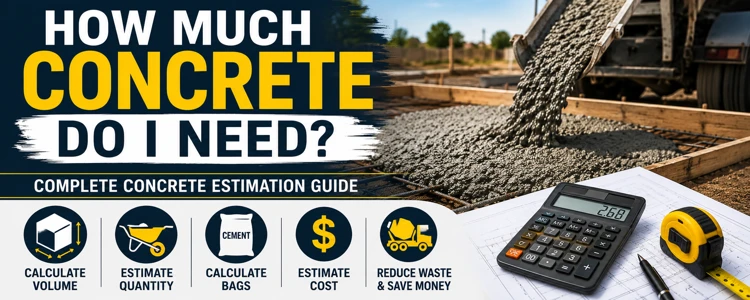
Estimating the correct amount of concrete is one of the most important steps in any construction project. Whether you are pouring a concrete slab, footing, driveway, patio, sidewalk, or foundation, accurate concrete estimation helps reduce waste, control costs, and avoid material shortages.
In this guide, you will learn how to calculate concrete volume, estimate cubic yards, determine cement requirements, and calculate concrete costs for construction projects.
Why Concrete Estimation Is Important
Incorrect concrete estimation can lead to:
- Material shortages
- Project delays
- Increased labor costs
- Construction waste
- Budget overruns
Professional contractors always estimate concrete volume carefully before starting construction work.
How Much Concrete Do I Need?
The amount of concrete required depends on:
- Length
- Width
- Thickness (depth)
The basic concrete formula is:
Length × Width × Depth = Concrete Volume
Step 1: Measure Length
Measure the total length of the area.
Example:
20 feetStep 2: Measure Width
Measure the width.
Example:
10 feetStep 3: Measure Thickness
Measure slab or footing thickness.
Example:
4 inchesConvert thickness to feet:
4 ÷ 12 = 0.33 feetStep 4: Calculate Concrete Volume
Formula:
Length × Width × Thickness
Example:
20 × 10 × 0.33 = 66 cubic feetConvert Cubic Feet to Cubic Yards
Concrete is usually ordered in:
Cubic yards
Conversion formula:
Cubic Feet ÷ 27Example:
66 ÷ 27 = 2.44 cubic yardsRequired concrete:
2.44 cubic yards
Add Waste Factor
Most contractors add:
5%–10% extra concrete
to account for:
- Spillage
- Uneven surfaces
- Form movement
- Construction waste
Example:
2.44 × 10% = 0.24Final estimate:
2.68 cubic yards
Concrete Needed for Common Projects
| Project Type | Typical Thickness |
|---|---|
| Sidewalk | 4 inches |
| Patio | 4 inches |
| Driveway | 5–6 inches |
| Garage Slab | 6 inches |
| Foundation Slab | 6–8 inches |
| Footing | 8–12 inches |
Thicker concrete requires more material.
How Many Bags of Concrete Do I Need?
If using ready-mix bags instead of truck delivery:
Approximate coverage:
- 60 lb bag → 0.45 cubic feet
- 80 lb bag → 0.60 cubic feet
Example:
66 ÷ 0.60 = 110 bagsEstimated requirement:
110 bags of 80 lb concrete mix
Concrete Cost Estimation
Concrete prices vary by:
- Region
- Supplier
- Mix design
- Delivery distance
Average ready-mix concrete prices:
$125–$170 per cubic yard
Example Concrete Cost
Example:
2.68 cubic yards
at:
$150 per cubic yard
Calculation:
2.68 × 150 = 402Estimated concrete cost:
$402
Factors That Affect Concrete Quantity
Several factors affect concrete requirements.
Slab Thickness
Thicker slabs require significantly more concrete.
Ground Conditions
Uneven ground may increase concrete usage.
Reinforcement
Projects using:
- Rebar
- Wire mesh
- Fiber reinforcement
may require different slab thicknesses.
Construction Waste
Always include additional material for safety.
Concrete Mix Ratios
Concrete mix design also affects material estimation.
Common mix ratio:
1:2:4
Meaning:
- 1 part cement
- 2 parts sand
- 4 parts aggregate
This ratio is commonly used for general construction work.
Use a Concrete Volume Calculator
Manual calculations can be difficult and time-consuming.
Our online Concrete Volume Calculator helps you:
- Estimate cubic yards
- Calculate concrete volume
- Estimate cement bags
- Calculate material quantities
- Estimate concrete costs
Using a calculator improves speed and accuracy.
Final Thoughts
Knowing how much concrete you need is essential for successful construction planning. Accurate estimation helps reduce waste, avoid delays, and improve budgeting for slabs, footings, patios, and foundations.
For fast and accurate results, use our online Concrete Volume Calculator to estimate cubic yards, material quantities, and concrete costs instantly.